 Caring Mother
Few things generate more quiet parental anxiety than a percentile. So let's start with the sentence every pediatrician repeats: a growth chart shows a trajectory, not a race. The 15th percentile is not a worse grade than the 85th — what matters is that your baby follows their own curve over time. The same is true of milestones: ranges are wide, and "may start doing now" beats "must do by."
What gets measured
- Weight — the most sensitive short-term signal of feeding and health
- Length/height — slower-moving, strongly genetic
- Head circumference — tracks brain growth in the first two years
- All three are plotted against reference curves (WHO standards for 0–24 months in most countries)
Reading a growth curve without panic
- Trajectory beats position. A baby steady on the 10th percentile is growing well; percentiles simply describe how measurements distribute across healthy babies.
- Wobbles are normal. Measurement error, a big feed, a growth spurt — single points move. What deserves attention is a sustained crossing of major percentile lines, which is your pediatrician's call to make.
- Early context matters. Newborns typically lose a little weight in the first days and regain birth weight by about two weeks — that dip is expected.
Milestones: what to actually watch
Development spreads across a few parallel tracks, each with a generous normal range:
- Movement & play — head control, rolling, sitting, crawling, standing, walking (anywhere from ~9 to 18 months is common for first steps)
- Talking & understanding — cooing, babbling, first words, following simple requests
- Feelings & connection — social smiles, stranger awareness, pointing, playing near other children
Milestone lists are most useful as a heads-up for what may come next — not as a checklist to test a baby against. If something on the "discuss with your doctor" lists appears (loss of skills, no response to sound, marked asymmetry), that's a conversation for your pediatrician, not a night of searching.
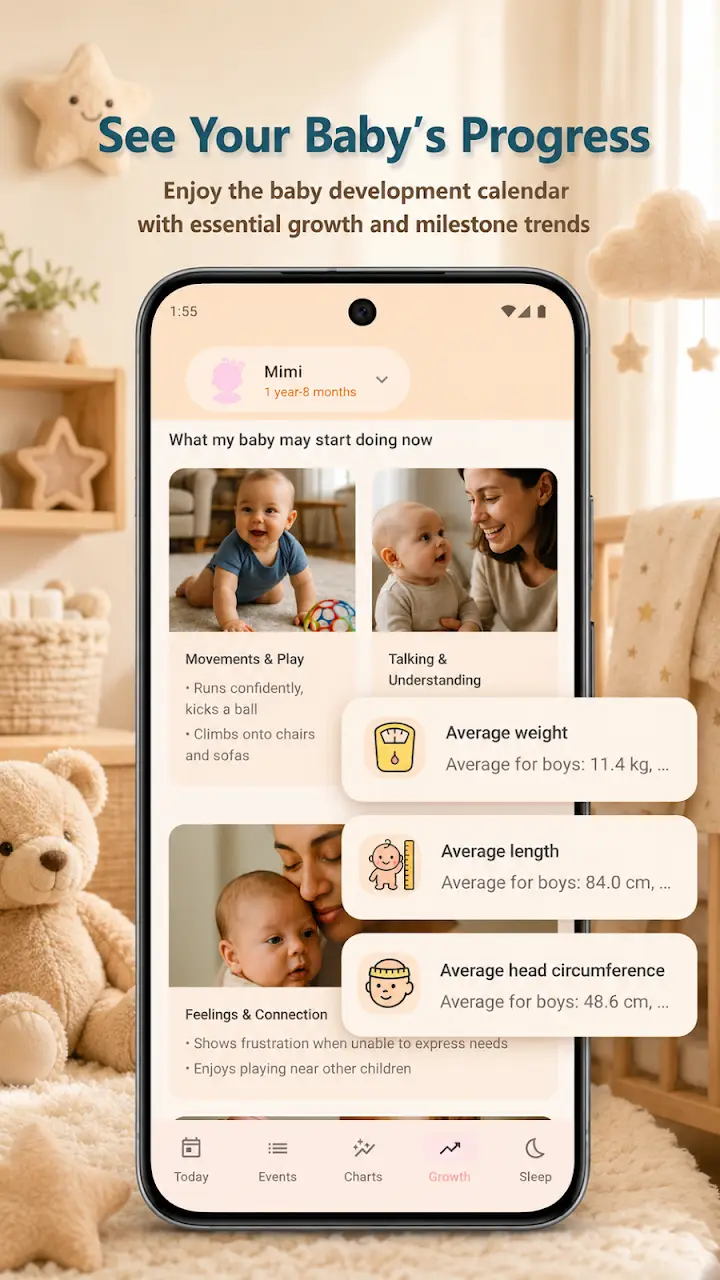
Tracking growth with Caring Mother
- Log weight, height and head circumference in seconds — right after each checkup is the perfect habit.
- Growth charts with typical-range bands plot your baby's curve against reference ranges, so trajectory is visible at a glance.
- A baby development calendar shows what your little one may start doing at their exact age — movements & play, talking & understanding, feelings & connection — with average weight, length and head size for orientation.
- Everything exports, so you can bring clean data to appointments (or grandparents).
A gentle tracking rhythm
Daily weighing serves anxiety, not information. A calm cadence: monthly measurements in the first year (plus whatever your checkup schedule adds), milestones noted as they happen. Growth connects to everything else — feeding fuels the curve (see our feeding schedule guide) and sleep needs shift with each developmental leap.
This guide is general information, not medical advice. Growth charts and milestones are interpreted by your pediatrician — bring questions to them, especially for premature babies, who are assessed by corrected age.