 Caring Mother
The short answer: a lot, and not on a neat schedule. Most breastfed newborns eat 8–12 times per 24 hours — roughly every 2–3 hours, counted from the start of one feed to the start of the next. Formula-fed newborns usually go a little longer, about every 3–4 hours by the end of the first month. At night, that means yes: newborns need to be fed around the clock at first.
Key numbers
- Breastfed: 8–12 feeds per 24 h (about every 2–3 h) in the newborn weeks
- Formula-fed: about every 3–4 h by the end of month one; 8 feeds/24 h is a common minimum early on
- Amounts: ~15–60 ml (0.5–2 oz) per feed in the first days → ~90–120 ml (3–4 oz) by one month
- Reassurance check: from day 5, at least 6 wet diapers a day suggests baby is eating enough
Typical feeding rhythm by age
| Age | Feeds per 24 h | Typical amount per feed* |
|---|---|---|
| 0–2 weeks | 8–12 (every 2–3 h) | 15–60 ml (0.5–2 oz) |
| 2 weeks–2 months | 8–10 | 60–120 ml (2–4 oz) |
| 2–4 months | 6–8 | 120–150 ml (4–5 oz) |
| 4–6 months | 5–7 | 120–180 ml (4–6 oz) |
*Bottle amounts; nursing babies regulate their own volume. Ranges are typical, not targets — your pediatrician's advice always wins.
Feed the baby, not the clock
Every major pediatric source — the AAP, CDC and Mayo Clinic among them — recommends feeding on demand, especially in the early months. The schedule above describes what usually happens; it isn't a timetable to enforce. Watch for hunger cues instead:
- Rooting (turning the head with an open mouth), lip smacking, sucking on hands
- Increasing fussiness — crying is a late hunger sign
- Stirring and mouthing during light sleep at usual feed times
Expect cluster feeding — stretches (often evenings, or during growth spurts around 2–3 weeks, 6 weeks and 3 months) when a baby feeds much more often than every 2 hours. It's normal and temporary, and it looks a lot less alarming when your log shows it as a pattern rather than a blur.
Why counting feeds matters (and why memory fails)
"When did she last eat?" is the most-asked question in any newborn household, and the honest answer from an exhausted brain is usually a guess. A baby feeding tracker turns it into a fact. It also matters medically: at checkups you'll be asked how many feeds and how many wet diapers per day — precise answers help your pediatrician assess weight gain and hydration quickly.
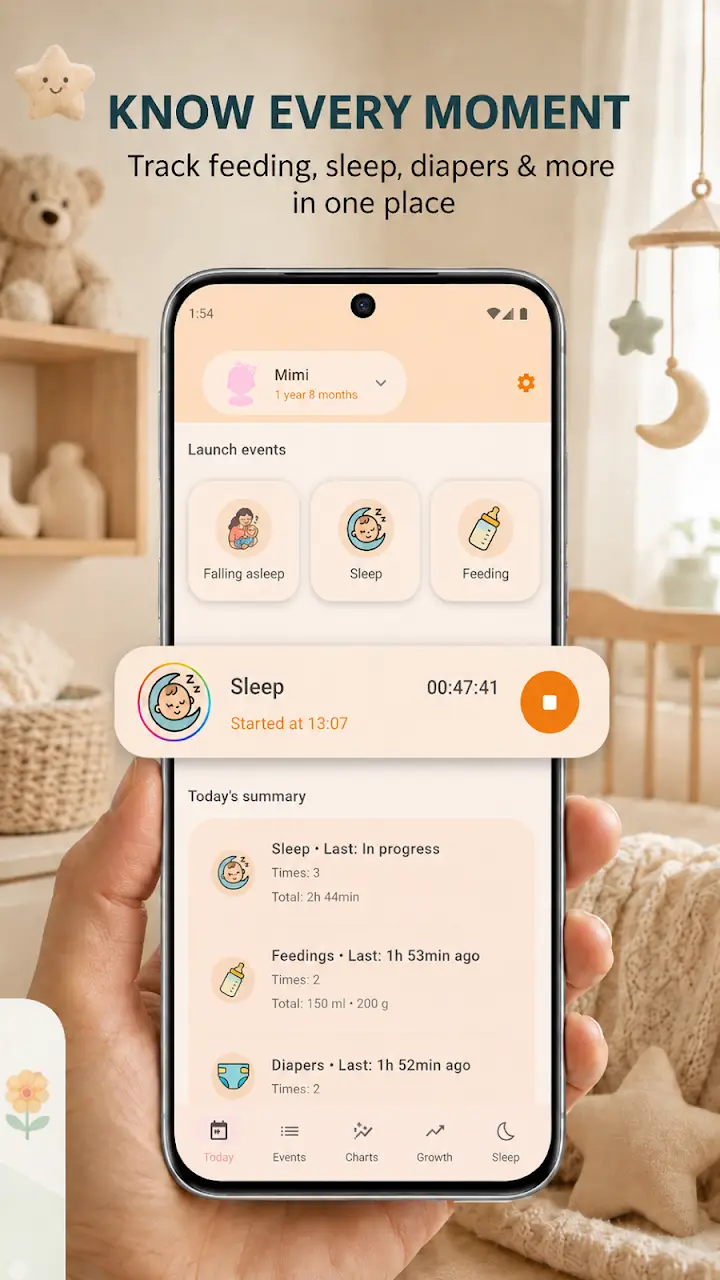
Keeping count with Caring Mother
- Log any feeding style — breastfeeding, bottle, formula, mixed feeding and solid food — in one calm flow, with amounts in ml and grams.
- "Last fed X ago" sits right on the Today screen, so anyone on duty can see it instantly.
- Feeding charts show feeds per day and daily rhythm over the week, making growth-spurt clusters and stretching night gaps visible.
- Works offline — 3 a.m. feeds get logged even with no connection, and sync catches everyone up later.
When to check with your pediatrician
- Fewer than 8 feeds per 24 h in the early weeks, or a baby too sleepy to finish feeds
- Fewer than 6 wet diapers a day after day 5 (see our wet diaper guide)
- No return to birth weight by about two weeks, or persistent feeding refusal
Feeding and sleep are tightly linked — a well-timed feed sets up a better nap. When you're ready, read our guide to wake windows and baby sleep tracking, or see how to track breastfeeding sides and duration.
This guide is general information for parents, not medical advice. Feeding needs vary — follow the guidance of your pediatrician, midwife or lactation consultant.