 Caring Mother
"Which side did I nurse last?" may be the single most-googled question of new motherhood — usually one-handed, in the dark, with a baby already latching. A breastfeeding tracker exists so that question always has an instant answer, and so the bigger picture (how often, how long, which rhythm) builds itself while you simply live your day.
What's worth recording
- Side — left, right or both; the next session usually starts on the fuller side
- Start time — feeding intervals are counted start-to-start
- Duration — useful for spotting trends, not for judging any single feed
- Optional notes — spit-up, fussiness, position that worked
Why the side matters
Starting on the side you ended with (or nursed less from) helps keep supply balanced and both breasts comfortable — starting repeatedly on the same side can leave the other engorged. Lactation consultants often suggest alternating the starting side; in practice nobody remembers this at 3 a.m. without a log. Some parents use a bracelet they move between wrists; a tracker does the same job and also remembers when, how long and how often.
What "normal" looks like
Newborns typically nurse 8–12 times per 24 hours, with sessions commonly lasting anywhere from 10 to 45 minutes — and both frequency and duration change week by week. Sessions get shorter and more efficient as babies grow. Evening cluster feeding is common and normal. Because the range of normal is so wide, the useful signal isn't any single number — it's your baby's own pattern over days: Is the rhythm roughly stable? Are night gaps slowly stretching? Is one side consistently shorter?
If you're supplementing or combining with bottles, log those too — the full picture is what makes the log meaningful. Our newborn feeding schedule guide covers overall frequency and amounts.
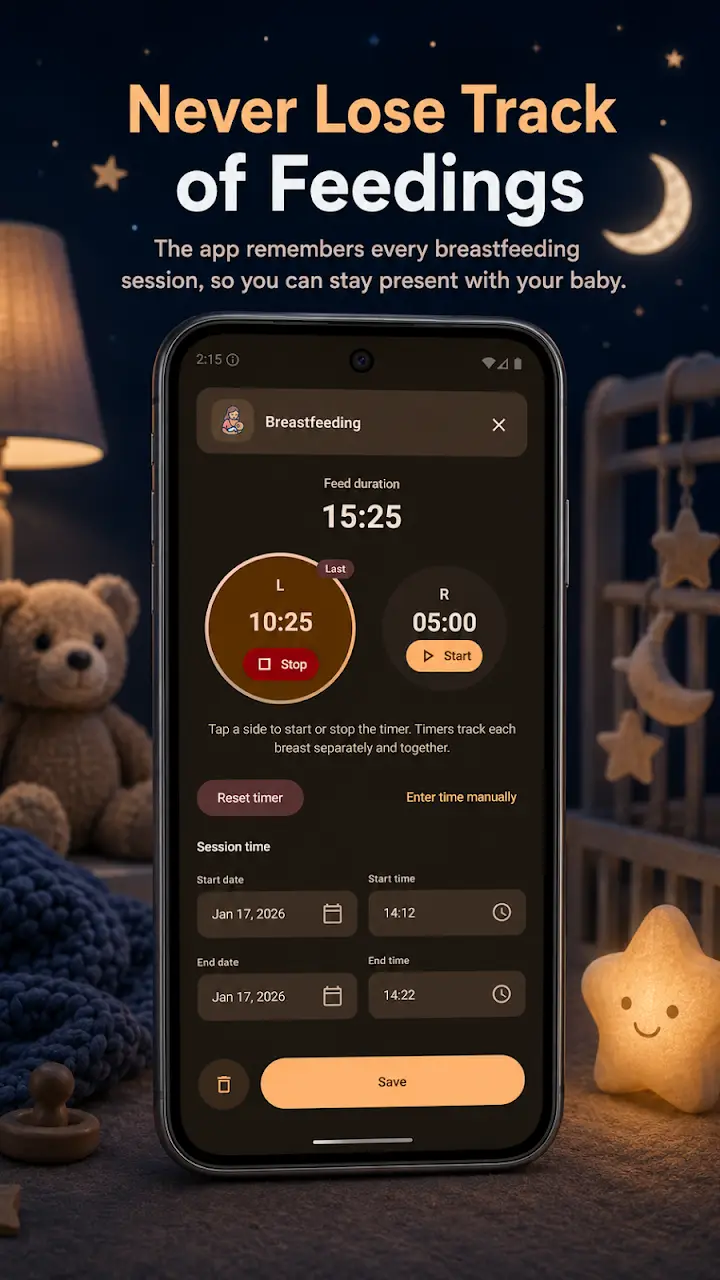
Tracking nursing with Caring Mother
- One tap starts a nursing session — pick the side, and a live timer runs while you feed. The timer keeps counting even if you switch apps or the screen locks.
- Left and right recorded separately, with duration per side, so "which side next?" is answered on the Today screen.
- Breastfeeding charts show minutes per side per day over the last 3, 7 or any custom number of days.
- Everything works offline and syncs later — night feeds never depend on Wi-Fi.
When tracking helps most — and when to relax it
- First weeks: track every session. It's the data your pediatrician and lactation consultant will actually ask about, alongside wet diaper counts.
- Supply worries: a week of honest logs tells you more than a day of anxiety. Bring the chart to your appointment.
- Once feeding is established: many parents drop duration and just tap side + time — or stop entirely. A tracker is scaffolding, not a lifestyle.
If you're also expressing milk, our pumping schedule guide covers how to keep a pump log alongside nursing.
This guide is general information, not medical advice. For latch pain, supply concerns or weight-gain questions, see a lactation consultant or your pediatrician.