 Caring Mother
Yes — white noise is considered safe for babies when it's used sensibly. The concerns aren't about the noise itself but about volume and placement. Get those two right and white noise is one of the simplest, most effective soothing tools there is: it recreates the constant whoosh a baby heard for nine months in the womb (which is surprisingly loud) and masks the household sounds that would otherwise startle a light sleeper awake.
The three safety rules
- Volume: around 50 dB — no louder than 60 dB (about the level of a quiet conversation or gentle shower)
- Distance: the sound source at least 7 feet / 2 meters from the crib — never inside it or right by baby's head
- Level: always the lowest effective volume — if it works quieter, go quieter
Why white noise works
- It's familiar. The womb was never silent; steady broadband sound feels like home to a newborn.
- It masks startles. A door, a sibling, a dog — sudden sound spikes wake babies from light sleep. A steady sound bed smooths them over.
- It becomes a sleep cue. Used consistently at naps and bedtime, the sound itself starts to signal "sleep now" — a handy, portable part of any sleep routine.
Can it run all night?
At a safe volume and distance, running sound through the night is generally considered reasonable — hearing risk scales with intensity and time, which is why the 50 dB guideline exists. That said, many families prefer sound only for the falling-asleep phase. An auto-off timer gives you the best of both: sound eases the transition, silence follows. (Practical check: if you must raise your voice to be heard over the machine while standing at the crib, it's too loud.)
Which sound? Not only "white"
Babies differ. Classic static-like white noise suits some; others settle faster to lower-pitched, more natural textures — rain, ocean waves, a fan hum — or to melodic lullabies during the wind-down. It's worth trying a few for several nights each rather than churning nightly.
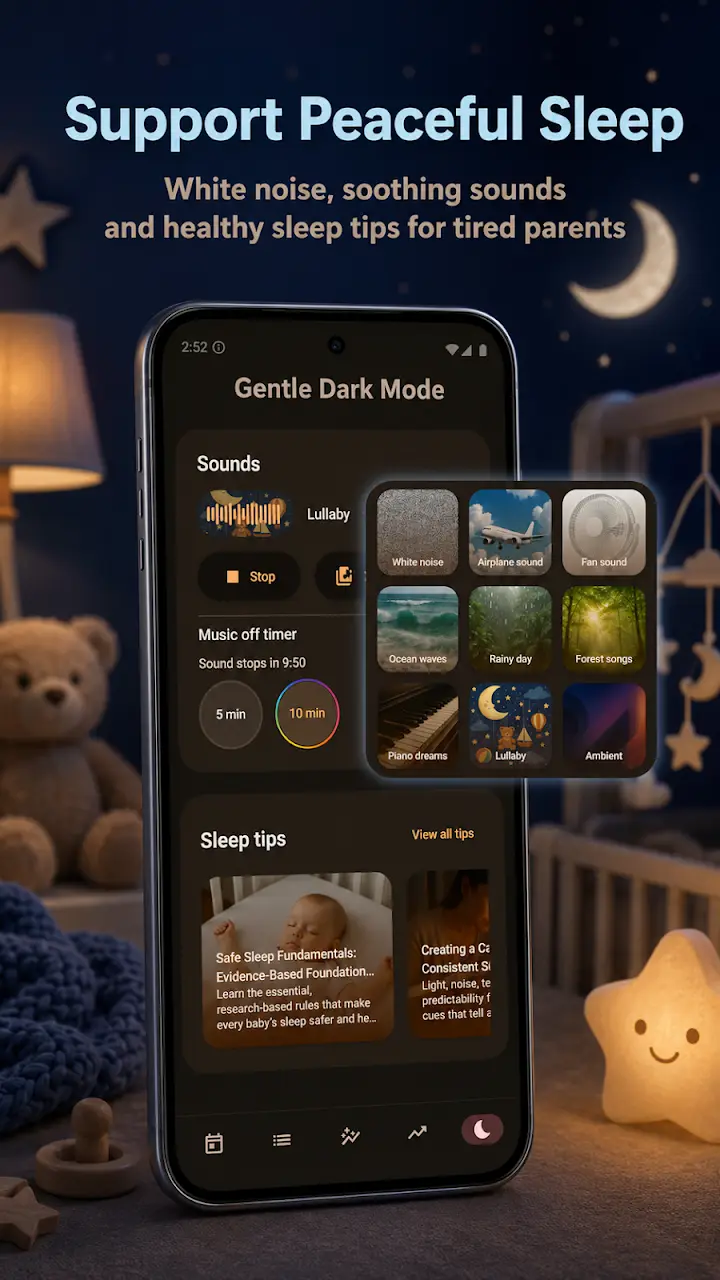
White noise built into Caring Mother
- 9 soothing sounds: white noise, airplane hum, fan, ocean waves, rainy day, forest songs, piano dreams, lullaby and ambient.
- Music off timer (5/10/30 min) — sound stops itself after baby drifts off, no tiptoeing back in.
- Gentle dark mode keeps the screen from lighting up the nursery during night feeds and logging.
- Sleep tips library with evidence-based articles on safe sleep and calm bedtime routines — right next to your sleep log, so soothing and tracking live in one app.
When to wean off white noise
There's no deadline — many toddlers (and adults) sleep happily with sound for years. If you want to stop, do it gradually: lower the volume a notch every few nights until it's off. If sleep falls apart, pause and try again in a few weeks.
This guide is general information, not medical advice. For hearing concerns or persistent sleep problems, talk to your pediatrician.